Planning for ACCESS: Key Takeaways from Our Expert Panel on Medicare's Next Chronic Care Model
Articles

April 16, 2026
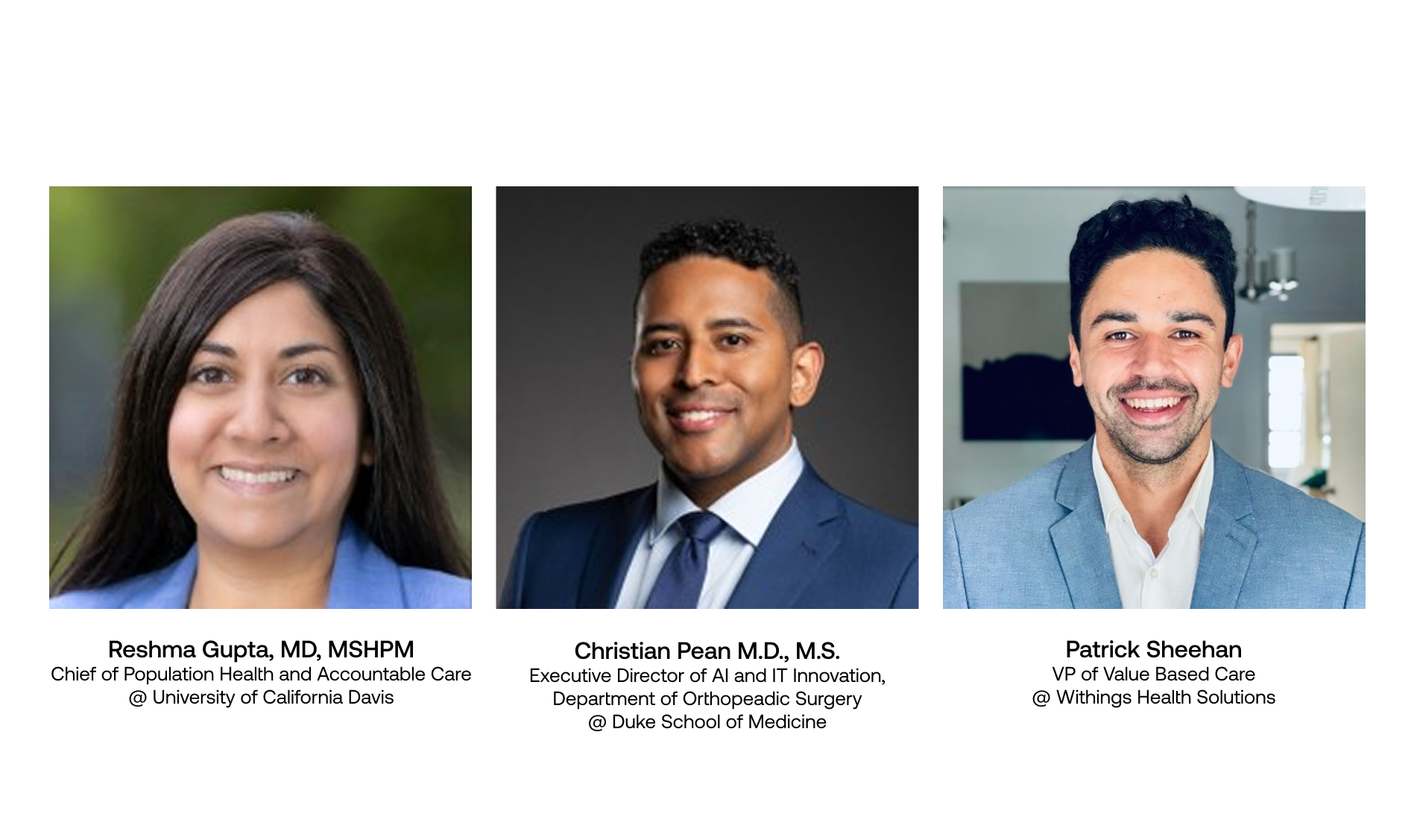
On April 14, Withings Health Solutions hosted a panel discussion with Dr. Reshma Gupta, MD, MSHPM, Chief of Population Health and Accountable Care at UC Davis Health, and Dr. Christian Pean M.D, M.S, Orthopedic Trauma Surgeon and Faculty at Duke University School of Medicine and CEO of RevelAI Health. The conversation, moderated by Patrick Sheehan, VP of Value Based Care at Withings, covered what the CMS ACCESS model means for health systems, how to build a strategy when you can't participate directly, and what it will actually take to make partnerships work.
Watch the full webinar on-demand >
The problem ACCESS is trying to solve
The session opened with a simple but important question: what gap is ACCESS designed to fill?
Dr. Gupta framed it from the patient's perspective. "Patients are seeking more engagement and wanting to take more ownership and transparency into their own care," she said. Getting a specialist referral in the traditional system can take four months, and ACCESS is designed to open up a faster, more proactive path to care. She also noted a systemic driver: the way remote monitoring has been billed under existing RPM and RTM codes has been "clunky," creating friction that ACCESS sidesteps with a cleaner, outcomes-based payment structure.
Dr. Pean pointed to two deeper gaps. First, a lack of longitudinal, asynchronous patient engagement: the kind of continuous care that happens between appointments, not just during them. Second, a lack of programs that are held accountable for outcomes rather than activity. "What CMS is hoping to do with ACCESS is provide patients a pathway to consumer-grade, technology-enabled care for chronic conditions," he said, "and accountability for the organizations delivering it."
Patrick Sheehan framed the distinction from an RPM perspective: ACCESS differs from traditional remote monitoring on three axes, enrollment (direct to beneficiary, not physician-ordered), technology (flexible, AI-inclusive, not just data transmission), and payment (outcomes-based, not activity-based).
ACCESS alongside RPM and RTM: complement or complication?
The panel was candid about the double-edged nature of ACCESS for health systems already running RPM programs.
Dr. Gupta called it exactly that: a double-edged sword. On one side, ACCESS accelerates the adoption of technology-enabled care at scale. On the other, it introduces new complexity: patients arriving with different levels of digital literacy, data coming in from outside the traditional health system, and care teams needing to adapt workflows accordingly. "How do we build a strategy to acknowledge that different patients are coming in with different things?" she asked. "That's good clinical care, but now some of them are going to have additional support from relationships that are outside the traditional healthcare system."
Dr. Pean saw ACCESS as an opportunity to uplift existing RTM strategies in musculoskeletal care, particularly for patients who would otherwise face long waits for physical therapy or orthopedic visits. He was especially energized by the fact that CMS confirmed physical therapists can serve as co-management partners under the MSK track, creating what he described as "a virtual extension of our physical therapists" and a meaningful data and engagement asset for health systems.
Developing a strategy when you can't participate directly
The FFS exclusion was a turning point in the conversation. Most health systems cannot participate in ACCESS directly, and yet their patients can choose to enroll with ACCESS participants on their own, without a referral. That creates an urgent strategic problem.
Dr. Pean was direct about the initial reaction: "We were disappointed when we saw how broad the fee-for-service exclusion was." But he reframed it as an opportunity to partner with technology-enabled organizations that may be more nimble than a health system could be on its own. His advice: don't ignore the model, and don't let it happen to you. "Health systems and ACOs should vet the participants who are now out in the open. You can search and see what organizations are participating, and strategically align and partner."
Dr. Gupta offered a ground-level view from UC Davis, where the financial reality hit hard. Post-COVID health systems are under enormous margin pressure, and any program that puts revenue at risk creates hesitation. "The tolerance for loss is very low," she said. Her framing of the opportunity was longer-term: ACCESS is a first step toward outcomes-focused care, and health systems' role, even without direct participation, is to build the ecosystem around it. That means training care teams to ingest external data, building interoperability workflows, and making strategic decisions about which partners to trust with their patient populations.
What care coordination actually has to look like
Patrick noted that if a health system simply meets CMMI's minimum requirements, a report at care period initiation and one at completion, that is a recipe for fragmentation. The panel agreed: the bar has to be higher.
Dr. Pean's priorities for a well-structured partnership: data transparency, a clear interoperability roadmap, a defined clinical governance model, and evidence that the program actually improves outcomes. He also emphasized patient experience: "Does my patient want that participant?" as a factor that hasn't traditionally entered into how health systems evaluate vendor partners.
Dr. Gupta made a strong case for the "crawl, walk, run" approach to integration. Not every clinic or service line will be ready on day one, and trying to roll out broadly at once is likely to fail. "If you throw this at primary care for all of these different areas all at once, it's going to sink," she said. The better path: start with the groups that are culturally ready and already have care management infrastructure in place, build workflows that work, and expand from there. She stressed that the infrastructure has to exist on both sides. "It's not a real partnership if the infrastructure is only on one side."
On medication management specifically, both panelists flagged it as the highest-stakes intervention in the CKM tracks. Dr. Gupta shared a concrete example: UC has aligned its hypertension medication titration algorithm across all campuses system-wide. If an ACCESS partner isn't following the same protocols, it undermines that work and creates real safety risk. "If it's not an approach that goes in the same direction, it can make a mistake," she said. The MSK and behavioral health tracks were seen as considerably lower risk on this dimension.
What health systems should be asking ACCESS participants
As the session moved into evaluating partnerships, three themes emerged consistently.
Interoperability and clinical governance. What is your roadmap to EHR integration? What is your clinical governance model? How do you handle escalation when a patient's condition changes, and are your protocols aligned with the health system's own?
Evidence and outcomes. Can you demonstrate that your program actually improves outcomes? CMMI will publish outcomes data for all ACCESS participants beginning after year one, effectively creating what Patrick described as a "Medicare App Store" where programs can be rated and compared. Until then, partners need to be able to make the case themselves.Long-term viability and strategic fit.
Dr. Gupta raised a question health systems are quietly asking: how many of these companies will still be here in five or ten years? Her answer wasn't to avoid the risk, it was to build internal workflows that don't depend entirely on any single partner. "The infrastructure has to be sustaining," she said. Dr. Pean pushed further: can a partner do more than just ACCESS? If you are going to integrate and build trust, the relationship should be able to grow.
A final note on patient choice
One of the most important and underappreciated dynamics that emerged from the conversation: the patient gets to decide. Even if a health system chooses a preferred ACCESS partner, their patients may choose a different program entirely. That makes the patient experience a genuine differentiator, not just a nice-to-have.
Dr. Pean closed with a call to lean in rather than pull back: "We should look for ACCESS participants that are going to be able to provide a premium patient experience longitudinally and expand access for our health system. We should embrace that, rather than being intimidated by it. But it has to be through deep partnerships."
This is a point worth sitting with. In conversations with CMMI, patient choice is not a footnote to the ACCESS model. It is the north star. The program was designed to empower beneficiaries to select the care program that is right for them, and that intent is shaping everything from how participants are evaluated to how outcomes will eventually be published and compared.
For health systems and ACOs thinking through ACCESS partnerships right now, that changes the calculus. The question is not only which participant has the most familiar model or the longest sales relationship. It is which participant will your patients actually choose, stay engaged with, and benefit from. That comes down to two things above all else: the quality of the patient experience, and the depth of integration back into the health system's existing workflows.
At Withings, those are exactly the two things we have spent over a decade building toward. There is a lot of noise in the ACCESS market right now, and a tendency to default to what feels familiar. We think that misses what matters most. The organizations that will define what good looks like in ACCESS are the ones that take patient experience and seamless integration seriously from day one, and we are focused on being one of them.
Want to continue the conversation? Reach out to our team at whs-marketing@withings.com or visit withings.com/health-solutions.